
ACS GC2 Practice Test PDF: Free Printable General Chemistry Second Term Questions and Answers
📝 Yes, a free ACS GC2 practice test PDF is available here. Get sample questions, answers and format tips for General Chemistry Second Term.
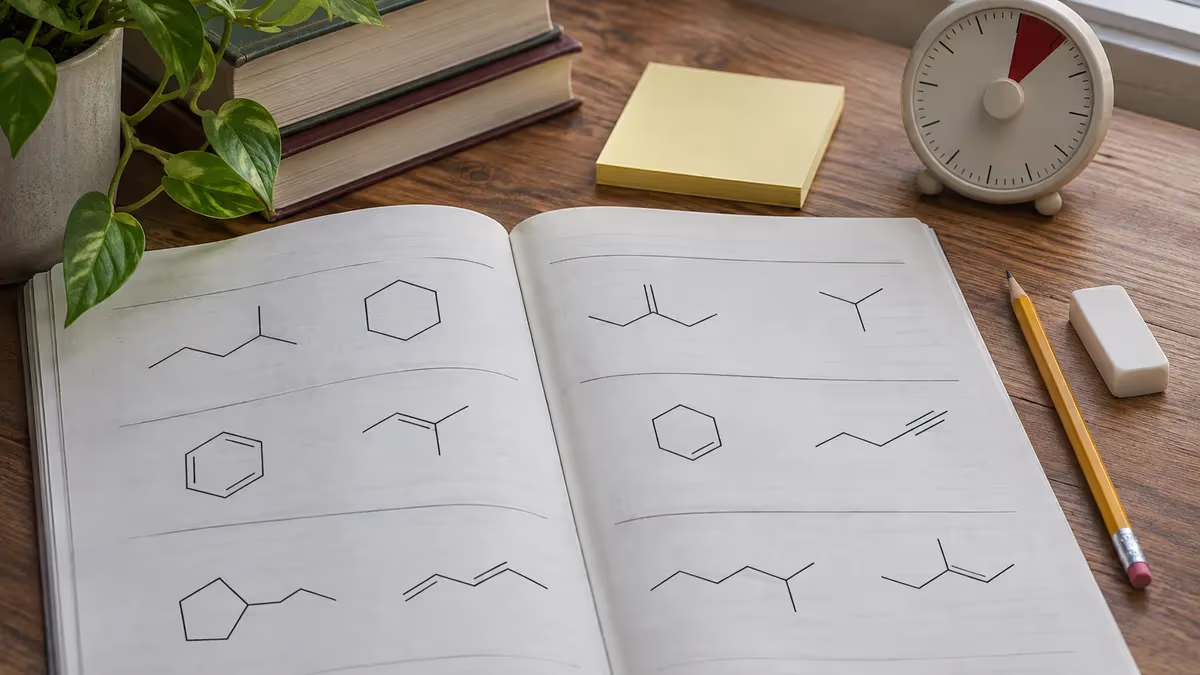
Yes, you can download a free, printable ACS GC2 practice test PDF on this page. It covers General Chemistry Second Term topics, including equilibrium, acid-base chemistry, kinetics, thermodynamics and electrochemistry, in the style of ACS Examinations Institute forms GC22S, GC17S, GC10S and the GC24SB Brief, with answers and explanations included.
Acs Gc2 Practice Test PDF: Key Facts (Updated November 2026)
| Fact | Details | Source |
|---|---|---|
| Who orders the exam | ACS Exams are ordered by chemistry departments, and the order form request should be made by the department chair. | ACS Exams (ordering information) |
| How it is delivered | Instructors order the exam with the department chair's signature on the order form. Answer sheets are scanned or shipped to ACS Exams for scoring. | ACS Exams (ordering information) |
| GC24SB Brief length | The ACS 2024 General Chemistry Exam – Second-Term Brief (GC24SB) is shortened to 50 items. | ACS Exams (exam materials) |
| GC24SB Brief time | The GC24SB Brief is designed to be completed in 55 minutes. | ACS Exams (exam materials) |
| Score reports | Score reports are generated within 24 hours of ACS Exams receiving scanned or shipped answer sheets. | ACS Exams (ordering information) |
| 2026 pricing | ACS Exams published a 2026 product and service price sheet, effective January 1 – December 31, 2026. | ACS Exams (pricing information) |
Before you print anything, know what the file is. The acs gc2 practice test hub on this site offers interactive questions with instant feedback, while the PDF on this page is a static, printable version you can mark up with a pen, time with a kitchen timer and review without a screen. Both target the same material: second-term general chemistry, the content that ACS second-term forms are written to measure.
The download is modeled on the General Chemistry Exam – Second Term family, with question styles drawn from the ACS Examinations Institute forms GC22S, GC17S, GC10S and the shortened GC24SB Brief. ACS keeps its real exam forms secure and distributes them through instructors, so no student PDF, including this one, can predict your exact questions. Treat it as a skills check: it shows whether you can handle the multiple-choice reasoning that second-term ACS exams reward.
Using the ACS GC2 pdf well takes about three passes. First, print it and work a block of questions under time limits. Second, grade yourself with the answer key and read every explanation, including those for questions you got right. Third, sort misses into concept gaps, arithmetic slips and misread questions. For the 50-item, 55-minute GC24SB Brief format, a good pace is roughly 66 seconds per item, which leaves no room for long recalculations.
Most students meet this exam because an instructor chose it as a final or unit test. ACS exams are ordered by chemistry departments, and the order form request should come from the department chair, so you cannot register for one yourself. After your class sits the exam, answer sheets are scanned or shipped to ACS Exams, which generates score reports within 24 hours of receipt. Your instructor then decides how and when to share results and how the score counts toward your grade.
Content comes from the second half of the general chemistry sequence. Expect chemical equilibrium and reaction quotients, acid-base chemistry with pH and buffers, chemical kinetics with rate laws, thermodynamics including entropy and Gibbs free energy, electrochemistry with cell potentials, and intermolecular forces with phase changes. Some departments also fold in solubility, nuclear chemistry or descriptive chemistry, so check your syllabus. The PDF concentrates on the six core themes of second-term courses.
Scroll down for the exam format, sample questions with worked explanations, a comparison of paper versus online practice, a study checklist, and answers to common questions. If you only have ten minutes, read the sample questions section and then attempt the PDF cold. Mistakes made in practice cost nothing, and they are the fastest way to find which of the six topics deserves your next study hour before the real test arrives.
ACS GC2 Exam Facts by the Numbers

What Is the Format of the ACS GC2 Exam?
| Section | Questions | Time | Weight | Notes |
|---|---|---|---|---|
| General Chemistry Second-Term Brief (GC24SB) | 50 | 55 min | 100% | Shortened form; other second-term forms may differ, so confirm with your instructor |
| Total | 50 | 55 minutes | 100% |
What Do ACS GC2 Practice Test Questions Look Like?
ACS GC2 practice questions are multiple choice, mostly conceptual with light calculation, and each one rewards a specific idea rather than raw arithmetic. The six samples below mirror the style of the downloadable PDF. Try each before reading the answer, and if you want more after these, the acs gen chem 2 practice exam hub has interactive sets. If you can explain why the wrong choices fail, you understand the concept.
Sample 1, equilibrium: at a certain temperature, N₂ + 3H₂ ⇌ 2NH₃ has equilibrium concentrations of 0.50 M N₂, 0.20 M H₂ and 0.10 M NH₃. What is Kc? Write Kc = [NH₃]² / ([N₂][H₂]³). That gives 0.010 / (0.50 × 0.0080) = 0.010 / 0.0040 = 2.5. The common wrong answer, 25, comes from forgetting to square ammonia, while 1.0 results from ignoring every exponent.
Sample 2, acid-base: what is the pH of 0.10 M acetic acid, Ka = 1.8 × 10⁻⁵? Because Ka is small, assume x is negligible beside 0.10, so x² = (1.8 × 10⁻⁵)(0.10) = 1.8 × 10⁻⁶ and x = 1.3 × 10⁻³ M. Then pH = −log(1.3 × 10⁻³) ≈ 2.87. Check the assumption: x is about 1.3 percent of 0.10, under the usual 5 percent cutoff, so the shortcut is valid.
Sample 3, buffers: a solution contains 0.20 M sodium acetate and 0.10 M acetic acid, with pKa 4.74. What is its pH? Use Henderson-Hasselbalch: pH = pKa + log([A⁻]/[HA]) = 4.74 + log(2.0) = 4.74 + 0.30 = 5.04. A fast check is available: more base than acid means the pH sits above the pKa. If your answer fell below 4.74, you inverted the ratio, a frequent slip.
Sample 4, kinetics: a first-order reaction has k = 0.0231 min⁻¹. How much reactant remains after 90 minutes? The half-life is 0.693 / 0.0231 = 30 minutes, so 90 minutes equals three half-lives. Starting material falls to (1/2)³ = 1/8, or 12.5 percent. Counting half-lives is faster than using ln[A] = ln[A]₀ − kt, and it avoids a calculator whenever elapsed time is a whole-number multiple of the half-life.
Sample 5, thermodynamics: for N₂ + 3H₂ → 2NH₃, ΔH° = −92 kJ and ΔS° = −199 J/K. Is the reaction spontaneous at 298 K? Convert entropy to kJ: −0.199 kJ/K. Then ΔG° = ΔH° − TΔS° = −92 − (298)(−0.199) = −92 + 59.3 = −32.7 kJ. Negative ΔG° means spontaneous under standard conditions. The classic trap is mixing joules with kilojoules, which would give an absurd ΔG° near +59,000.
Sample 6, electrochemistry: a Zn|Zn²⁺ and Cu|Cu²⁺ cell uses reduction potentials of −0.76 V and +0.34 V. Find E°cell and ΔG°. E°cell = 0.34 − (−0.76) = 1.10 V. With n = 2, ΔG° = −nFE° = −(2)(96,485)(1.10) ≈ −212,000 J, or −212 kJ. Never multiply potentials by coefficients when balancing half-reactions, because E° is intensive; only n changes. That single idea resolves many electrochemistry distractors.
How Do You Use an ACS Gen Chem 2 Practice Exam PDF?
Start by deciding what you want from the session. If your instructor has announced that the final will use an ACS second-term exam, aim for a full timed run. If you are still learning material, print only the questions for topics you have covered and save the rest. Print single-sided with wide margins so you can write work next to each problem, and keep a pencil, eraser and scratch paper ready.
Gather the tools your real exam will allow. Ask your instructor whether a calculator and periodic table are provided, and mimic those conditions. Put your phone out of reach and set a timer to 55 minutes if you are attempting a 50-item block like the GC24SB Brief. A realistic setup makes the practice result a far more honest measure of readiness than casual studying with notes open.

Is a Practice Test PDF Better Than Online Practice?
- +It is free to download and print, so there is no cost barrier.
- +It works offline, which suits libraries, commutes and low-signal dorms.
- +Paper mimics the pencil-and-bubble feel of a scanned answer sheet.
- +You can annotate, circle and show full work beside each problem.
- +A printed test removes screen distractions and notifications.
- +It is easy to time as one uninterrupted block.
- −You get no instant feedback until you grade it yourself.
- −The questions are the same every attempt, so memory can inflate scores.
- −It cannot adapt difficulty to your weak areas.
- −It does not track your scores or topic trends automatically.
- −You cannot filter by topic without sorting pages by hand.
- −It is practice material, not the secure exam your class will take.
What Should You Do With the ACS GC2 Practice Test PDF?
- ✓Download and print the PDF single-sided with wide margins.
- ✓Confirm with your instructor which ACS second-term form your class will use.
- ✓Set a timer for 55 minutes before attempting a 50-item block.
- ✓Work in order and circle any question that takes over two minutes.
- ✓Write units and exponents on every calculation line.
- ✓Grade with the answer key in a different color pen.
- ✓Read the explanation for every item, including correct answers.
- ✓Tally misses by topic: equilibrium, acid-base, kinetics, thermodynamics, electrochemistry, intermolecular forces.
- ✓Re-solve each missed problem from a blank page within 24 hours.
- ✓Repeat a timed block in four to five days and compare scores.
Grade by topic, not just by total
A single percentage hides where points leak. Sort every miss into one of six topics and fix the topic with the most errors first. Two hours on your weakest topic usually beats two hours spread evenly across all six.
Which ACS GC2 Topics Should You Study First?
Study first the topics that connect to the most others: equilibrium, acid-base chemistry and thermodynamics. Equilibrium ideas feed buffers, solubility and electrochemistry, while thermodynamics explains why equilibrium constants take the values they do through the relationship ΔG° = −RT ln K. Kinetics and intermolecular forces matter just as much on the exam, but they interlock with fewer other topics. Spend your first week building fluency in the linked trio, then widen to the rest.
For equilibrium, master three moves. Compare Q to K to predict direction: if Q is less than K, the reaction shifts toward products. Build ICE tables for any problem that gives initial amounts. Apply Le Chatelier's principle qualitatively when a question changes pressure, volume, temperature or concentration. Remember that only temperature changes the value of K, and that adding a catalyst speeds both directions equally without shifting the position of equilibrium at all.
In acid-base chemistry, classify before calculating. Strong acid or base means stoichiometry; weak acid or base means an equilibrium table; a mixture of a weak species with its conjugate means a buffer. For titrations, picture the curve. Titrating 25.0 mL of 0.100 M HCl with 0.100 M NaOH reaches equivalence at 25.0 mL and pH 7, whereas a weak acid titrated by a strong base reaches equivalence above pH 7 because its conjugate base hydrolyzes.
Kinetics questions revolve around rate laws and graphs. Determine reaction order from initial-rate data: if doubling [A] quadruples the rate, the reaction is second order in A. Linear plots identify order too: ln[A] versus time is linear for first order, and 1/[A] versus time is linear for second order. For temperature, the Arrhenius equation says a higher activation energy makes the rate more sensitive to heating. Mechanism questions ask which step is rate-determining and which species are intermediates.
Thermodynamics questions test signs and logic. Entropy rises when a solid becomes a gas or when the moles of gas increase. Spontaneity depends on ΔG = ΔH − TΔS, so a process with positive ΔH and positive ΔS becomes spontaneous only at high temperature. Relate ΔG° to K: negative ΔG° means K is greater than 1. Standard-state values differ from conditions in a real flask, which is why ΔG, not ΔG°, decides direction at any moment.
For electrochemistry, learn the vocabulary first: oxidation occurs at the anode, reduction at the cathode, electrons flow from anode to cathode through the wire, and ions migrate through a salt bridge. Then use E°cell = E°cathode − E°anode, and the Nernst equation, E = E° − (0.0592/n) log Q at 25 °C, to predict what happens when concentrations change. A cell with Q greater than 1 has a lower potential than standard, and at equilibrium E equals zero.
Intermolecular forces and phase changes close the list. Rank boiling points by hydrogen bonding, then dipole-dipole forces, then London dispersion forces, adjusting for molar mass and molecular shape. For heating curves, use q = m·c·ΔT within a phase and q = m·ΔH during a phase change. Melting 10.0 g of ice at 0 °C needs about 3,340 J, since the heat of fusion of water is roughly 334 J/g. Plateaus on a curve signal phase changes, not stalled heating.
ACS Exams are ordered by chemistry departments and distributed through instructors, so the real forms are not available to students. Use this PDF to build skills and pacing, and ask your instructor which form and rules apply to your class.
How Do You Score and Review an ACS Gen Chem 2 Practice Exam?
Score your attempt by counting correct answers, then dividing by the number of questions you attempted under the clock. If you worked 50 items and answered 34 correctly, that is 68 percent. Record this number, the date, and the time it took. A single score means little, but three scores spread across two weeks show a trend, and a trend tells you whether your study method is working or needs to change.
Next, build an error log with four columns: topic, question number, why you missed it, and the fix. Classify each miss as a concept gap, a calculation slip, a misread question or a time-pressure guess. Concept gaps need rereading and new practice problems. Calculation slips need slower, cleaner work with units on every line. Misreads need underlining the question stem. Time-pressure guesses need a pacing plan. Patterns appear quickly, often within the first twenty misses.
Pair the paper work with a gen chem 2 acs practice exam in an online format when you want instant feedback on a single topic. The PDF is best for stamina and pacing, since it forces you to commit to answers without hints, while online questions are best for fast repetition on a weak area. Alternate them: one timed PDF block, then two or three topic-specific online sets that target whatever your error log flagged.
Be careful about how you interpret your percentage. Practice questions written by different authors vary in difficulty, so a score on one set does not map neatly onto a real exam result. Your instructor decides how the official exam counts, and ACS Exams generates score reports only after answer sheets are scanned or shipped to it. Use practice scores as a relative guide to your own progress, never as a promise about the final grade.
Review right answers too. A correct answer reached by luck is a hidden weakness. After each block, pick five questions you answered correctly with low confidence and explain them aloud, as if teaching a classmate. If you cannot articulate why each wrong option fails, reclassify the item as a miss. This habit converts guesses into knowledge and tends to raise scores faster than attempting a brand-new set of questions every single day of the week.
Retest on a schedule. Re-attempt the questions you missed after two days, then again after a week. Spaced repetition beats rereading because retrieval strengthens memory. Keep the error log beside your textbook problem sets, and when an instructor posts a quiz or midterm, add those misses to the same log. By the final week, your personal list of recurring traps is often more useful than any commercial review book you could buy.
Know when to stop drilling. If your last two timed blocks land within a few points of each other and your misses are mostly careless slips, extra volume gives diminishing returns. Switch to targeted review of the single weakest topic, rest well before the exam and arrive with sharpened pencils. Because answer sheets are scanned, darkly filled bubbles and complete erasures matter as much as chemistry knowledge on the day of the exam.
What Are the Best Final-Week Tips for the ACS GC2 Exam?
In the final week, shift from learning new material to rehearsing retrieval. Take one full timed run of the PDF about five days before the exam, review it thoroughly, then spend two days on your weakest topics. Taper to light review in the last forty-eight hours. Cramming new methods at the last minute usually creates confusion between similar formulas, while rehearsing what you already know builds the calm that carries you through the tough items.
Pace deliberately. On a 50-item, 55-minute format, 66 seconds per item is the average, so mark any question that stalls you past two minutes, choose your best guess and move on. Return in a second pass if time remains. Easy points are scattered through the exam, and a single hard equilibrium problem should never consume the time that three straightforward conceptual questions would have rewarded you for answering correctly.
Use elimination aggressively. ACS-style distractors are built from predictable errors: a flipped ratio, a missing exponent, a sign mistake or a unit mismatch. Before calculating, estimate the answer's size and sign, then discard options that cannot be right. In the buffer example, any pH below the pKa is impossible when base exceeds acid. Ten seconds of estimation often removes two choices and turns a hard problem into a coin flip you can improve.
Confirm logistics with your instructor, because departments order and administer these exams. Ask which resources are provided, such as a periodic table or equation sheet, whether a calculator is allowed and which type, how long you have, and whether unanswered questions count differently from wrong ones. Do not assume the rules match a friend's class. Policies vary by instructor and course, and knowing yours removes avoidable stress from the morning of the test.
Handle the answer sheet carefully. Because answer sheets are scanned or shipped to ACS Exams for scoring, fill each bubble completely with the pencil type your instructor specifies, erase changes cleanly and check periodically that your answer number matches the question number. Skipping a question and then shifting every later answer by one row is a classic disaster. Glance at the sheet after every ten items to catch that kind of misalignment early.
Protect your basics. Sleep seven to eight hours the night before, eat a normal breakfast and arrive early. Review a one-page summary of formulas, such as Kc expressions, Henderson-Hasselbalch, the integrated first-order rate law, ΔG = ΔH − TΔS and E°cell = E°cathode − E°anode. Writing that sheet from memory is itself a useful practice drill, even when you cannot bring it into the exam room with you.
Finally, keep perspective. One exam rarely defines your whole course grade, and your instructor controls how it counts. Use the PDF, the topic quizzes and your error log to put in honest, focused practice, then trust that work. Students who practice under realistic conditions tend to feel familiar with the format on exam day, and that familiarity frees mental energy for the chemistry itself instead of leaving it tied up in nerves.
ACS GC2 Questions and Answers
Written and edited by Nathan Beja, founder of Practice Test Geeks, with AI assistance. Exam facts are checked against the official sources linked below. Editorial policy
Sources & references
Exam facts on this page (fees, format, dates, passing scores) are checked against these official sources; the date is our last check. Editorial policy
- uwm.edu — Test delivery, score release, exam format, time limit, eligibility, exam information · verified Nov 2026